All features / Drawing & coloring
Area Paint and Stack Paint brushes
Need to fill an irregular shape without tracing a perfectly closed outline? Draw the region and release to color it. Choose how overlapping strokes should behave.
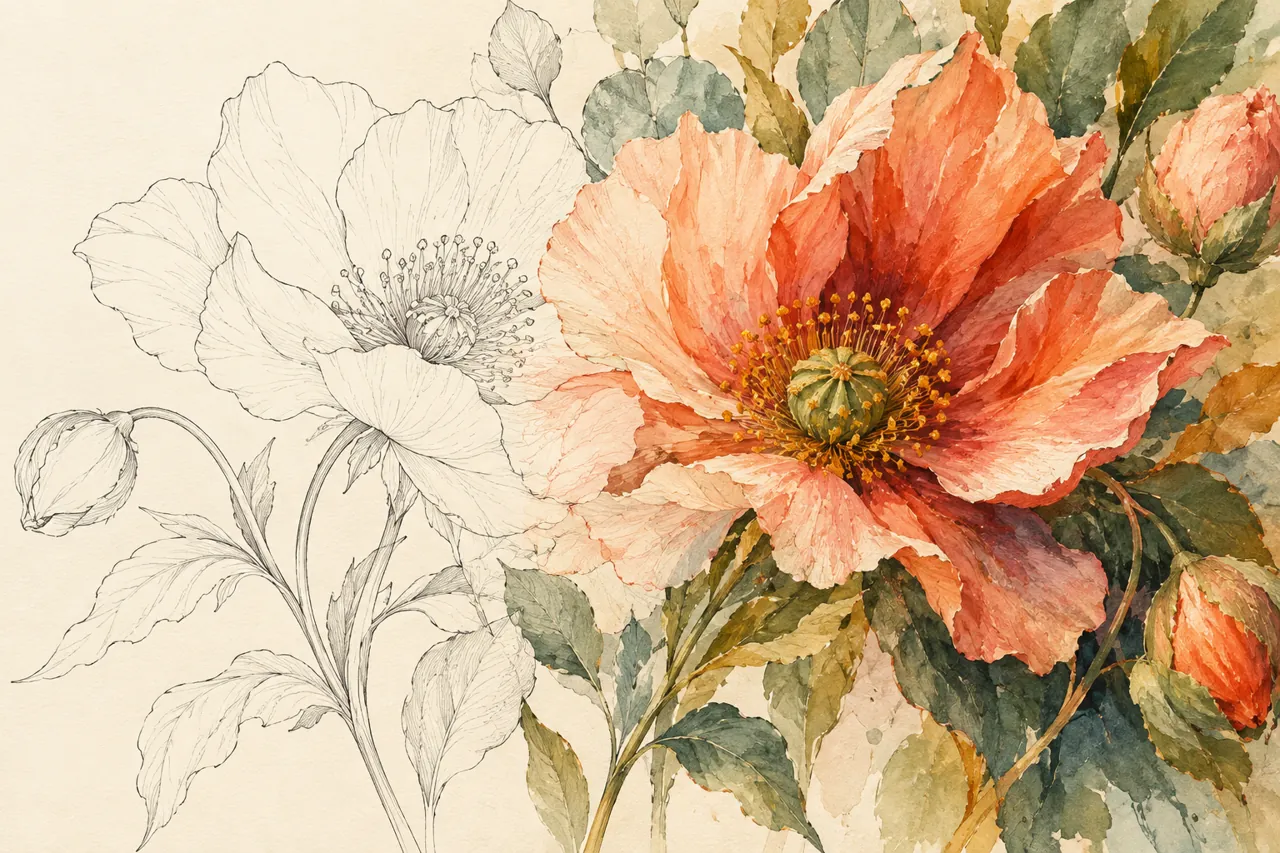
WORKFLOW
How it fits your workflow
Fill a hand-drawn region in one gesture
Clear overlap with Area Paint or retain it with Stack Paint
Useful for flats, organic edges and layered color
Practical details before you begin
A normal fill bucket depends on a well-defined boundary. Area Paint lets you draw the area yourself, which is useful when a sketch has gaps or the shape should have a hand-drawn edge. Release the stroke to fill that shape.
For overlapping passes, Area Paint clears the repainted portion while Stack Paint keeps the color already present. Choose the behavior before laying down broad flats, then refine the result on its own layer.
STEP BY STEP
How to use it in the software
Circle & Overlap Pens: fill large areas fast
In one sentence
Both pens fill a flat colour in one gesture: drag a loop, release, and the enclosed area is painted with the current foreground colour. No closed line art is needed (unlike the paint bucket) and no back-and-forth brushing. Large base colours and separate colour blocks take one loop.
Three steps
1. Find the circle pen in the toolbar, click the small triangle on its slot to expand, then pick Circle Pen or Overlap Pen.
2. Set the foreground colour with the colour picker and keep the Fill mode in the properties panel.
3. Drag a loop around the area on the canvas and release. You can wind back and forth inside the loop; every bounded area it encloses counts as painted.
The difference
Circle Pen: sweeping over an already painted area cancels the colour there and reveals the layer below; untouched areas are filled as usual. Re-trace a mistake to remove it. If the whole stroke lands on old colour, the status bar reports that only cancellation happened.
Overlap Pen: sweeping over an already painted area keeps the first colour and does not cancel it; only new areas get the current foreground colour. Scribble a figure eight or cross your own stroke and the crossings stay solid, with no white holes.
Use Overlap Pen for one-pass flat fills without worrying about overlap. Use Circle Pen when you want to revise as you go, separate two colour blocks or cut holes.
Both pens yield only to fills made by these two pens. Photos, line art and ordinary brush strokes are not preserved and will still be covered.
What the properties panel controls
Four modes: Fill (an editable fill object), Erase (removes content on the current layer), Make Selection, and Layer Mask.
Fill opacity 1-100% controls colour strength; in Erase mode the same control becomes Erase opacity.
Edge feather 0-32 px softens the outline for gentle transitions.
Hold Shift before pressing to add this loop to the previous circle fill; hold Alt before pressing to subtract this loop as a cut-out. Pressing them halfway through a stroke has no effect.
When to use something else
Closed line art and a single click: the paint bucket is faster. Gradients or texture: the gradient tool or a brush.
A locked layer or an unapplied layer mask blocks the fill; the status bar explains why.
After the Circle Pen cancels a colour, nothing remembers that the spot was painted. Dragging that fill's nodes later can claim the area back. Duplicate the layer first if you need to refine its shape.
STEP BY STEP
Feature 15 · Circle & Overlap Pens
Need exact settings and steps? Read the matching chapter of the in-app manual online.